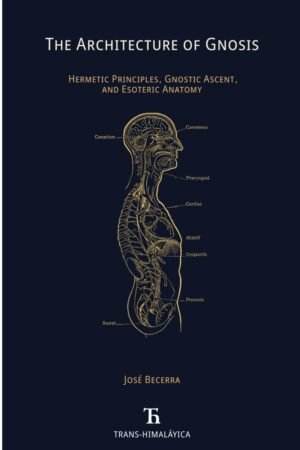
The Architecture of Gnosis began and ended with a key. “The Principles of Truth are Seven,” the Kybalion had promised in 1908, and whoever knows them holds the key before which every door of the Temple opens. That book turned the key together with a second one, James Morgan Pryse’s reading of the Apocalypse as a map of the human body, and it ended with a body that becomes a temple.
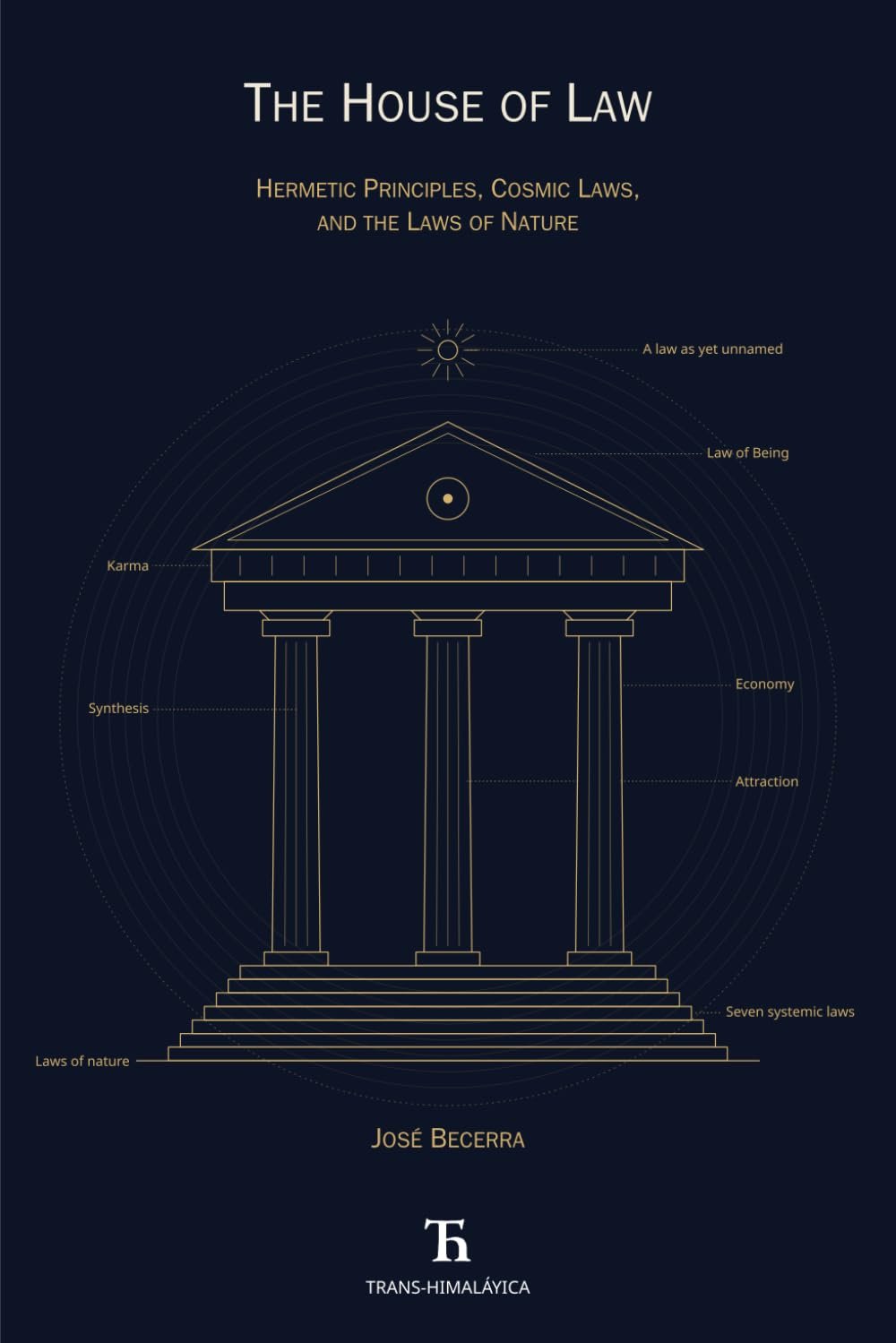
The House of Law, its sequel, follows the key to the house. In 1925 a treatise from New York described the house those doors belong to: a Law of Being at the roof, three cosmic laws, an intermediate law from Sirius, seven systemic laws and some hundred and forty more. And in 1931 William Walker Atkinson, the lawyer who wrote the Kybalion, finished a last code of seven cosmic laws and put it away. It would not be printed for eighty years.
This book reads the three codes side by side and sets them beside the laws of physics. It follows the laws named in the books of Alice A. Bailey, from the cosmic triad of Synthesis, Attraction and Economy down to the laws of the soul and of the group, and finds where the Kybalion’s seven principles and Atkinson’s last code belong within them. It goes back to Hermes: to the Emerald Tablet, printed in a footnote of A Treatise on Cosmic Fire; to the Seven Rulers of the Poimandres and their government of Fate; and to Mercury, the messenger. And it carries the inquiry from the body of a man to the body of a Logos, taking gravitation, least action, relativity, causation and entropy one by one, and naming in each case the kind of relation claimed and the evidence behind it.
The method is the first book’s. Three kinds of statement are kept apart: what the texts say, what history shows, and what the author proposes. Physics is treated as analogy unless a law is measured. The author, a physician who spent his career in mathematical epidemiology, brings that discipline to the Trans-Himalayan teaching, most directly in a chapter on karma and the unmeasured cause.
Under every code lies the oldest question about law: whose law is it? Science set the lawgiver aside. The lawyer left him undecided. The Tibetan named him, gave him a body, and described a life that comes to fulfil every law it once obeyed.
The House of Law can be read on its own; readers of The Architecture of Gnosis will find the same sources and the same Hermetic thread carried one floor higher. With a comparative concordance, a glossary, a taxonomy and catalogue of the laws in the Bailey books, and an appendix on Michael D. Robbins’s proposals for the rays of Mercury and Venus.
Descubre más de Editorial Transhimaláyica
Suscríbete para recibir las últimas entradas en tu correo electrónico.