Two keys to the same door.
In 1908 a small book from Chicago, The Kybalion, promised its readers a Master-Key: seven Hermetic principles that would open every door of the Temple. Two years later the Theosophist James Morgan Pryse published The Apocalypse Unsealed, which read the Book of Revelation as a map of the human body, its seven churches, seals and trumpets set along the spine.
The Architecture of Gnosis turns the two keys together.
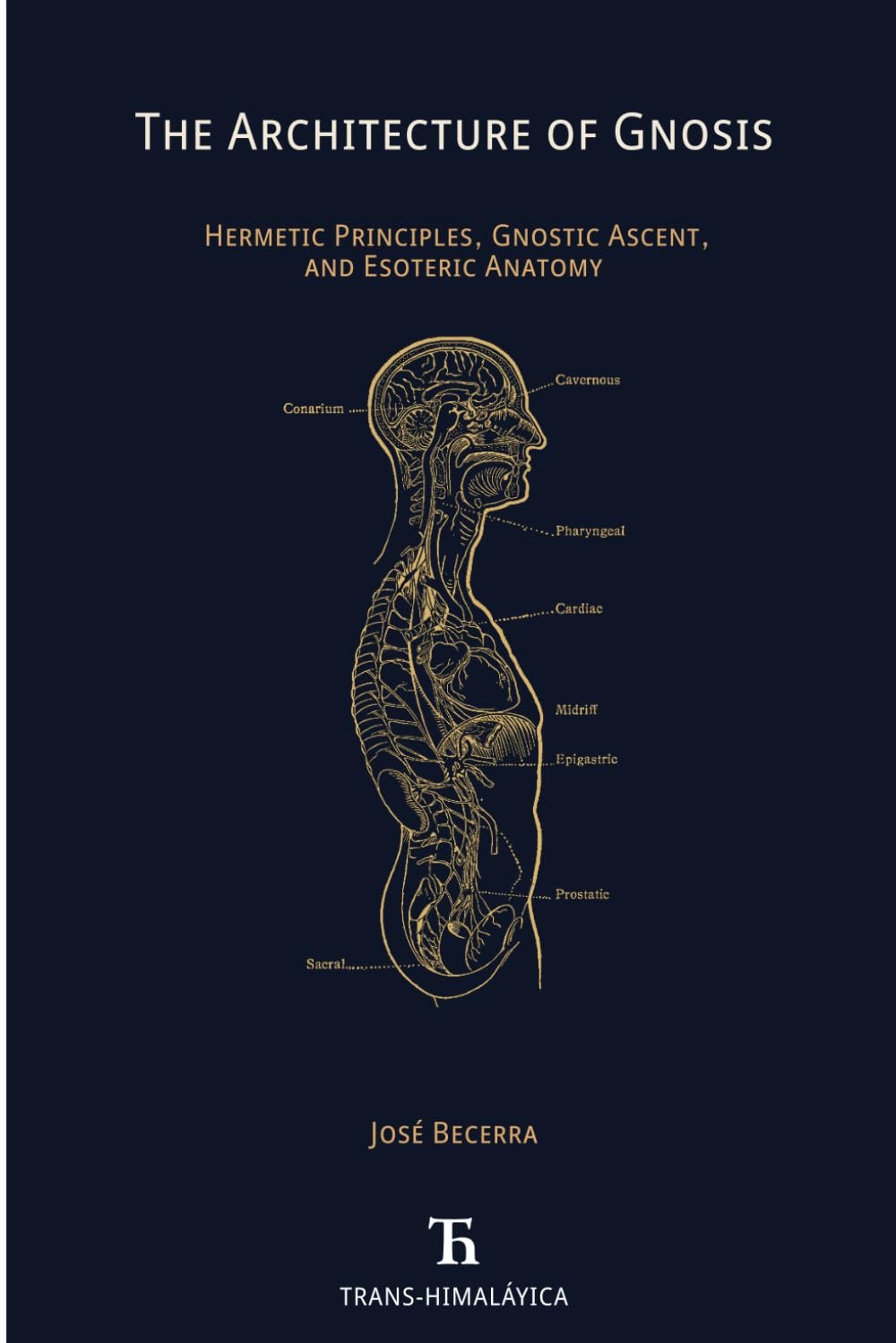
It reads the Kybalion’s seven principles through the Seven Rays of the teaching given through Alice A. Bailey. It follows the Hermetic and Gnostic writings from Alexandria to the jar dug up at Nag Hammadi in 1945, and to the vision of Mary in the Gospel of Mary. And it walks with Pryse through the churches, horsemen and beasts of the Apocalypse to the city foursquare, which, unfolded, takes the shape of a man.
What you will find inside:
- The Kybalion’s seven principles, set out again in the order of the Seven Rays
- Thoth becoming Hermes Trismegistus, and what the Corpus Hermeticum actually says
- The soul’s ascent past the powers in the Gospel of Mary
- Pryse’s esoteric anatomy: the seven centers, the serpent-fire and the solar body
- The numbers of Revelation, from the 144,000 to the cube of the New Jerusalem
- A comparative concordance, a glossary, and Pryse’s word-numbers recomputed
A book that shows its sources. It keeps three kinds of statement apart: what the texts say, what history shows, and what the author proposes. Every quotation is cited to an edition and a page, and every interpretation is marked as the author’s own. Modern physics is used as analogy, never as proof.
What emerges is not a single system but a shared direction: intelligence brought into the service of Love-Wisdom, and a body that becomes a temple.
Descubre más de Editorial Transhimaláyica
Suscríbete para recibir las últimas entradas en tu correo electrónico.